Monday, November 22, 2010

Once More Into the Breach


We’re late. Again.

Dr. Ross makes it a common joke in the van, the fact that we are always running on “Nicaragua time." This means we’re chronically late for everything, usually by at least an hour. For Americans who are used to getting where they need to be exactly when they need to be there, this can quickly grow frustrating. Flexibility is the name of the game in developing countries. Today, it’s the visit to UPOLI that holds us up. There’s a lecture for us this Monday morning that gives us a general synopsis of the current state of Nicaraguan healthcare. It’s interesting, but time-consuming nonetheless. 

Tardiness, however, works to my advantage this morning. It allows for an unforeseen reunion with a good friend of mine and many others. As I walk out to the bus for the ride to the barrio, his familiar face pops out from behind his white van. It’s our faithful UPOLI driver, Don Pedro!


I begin relaying the half dozen messages that I've been instructed to pass along to him by my classmates from my last trip. He asks about the RMU nursing students, particular Megan, who rode in the front seat with Don Pedro last year. For ten days, the two of them had attempted to cross the language barrier by coming up with some sort of code language. Don Pedro still knows all their catch phrases.

Finally we are under way toward our adopted neighborhood, the Anexo Villa Libertad barrio. The van stops outside the clinic and after brief instructions, we head out on foot. The streets of the barrio are already well baked by the sun when we begin our hike. We are going to be working in an area of the barrio that I haven't been in before. After walking a few blocks from the clinic, we have to cut off the dirt road onto a path to reach our family's homes.


The path takes us along the edge of a small ravine, overgrown with weeds and filed with the ever-present stench of rotting garbage. It's a dirty area, but there's a silver lining to be found in the abundance of foliage that blocks the sun's harsh rays. 

When the students arrive at their families' homes, there is that general sense of first-day apprehension. Some are better at hiding it than others, but every nursing student knows that feeling. You're about to enter someone else's life. You're on the verge of inviting yourself into a stranger's privacy. It's your job, yes, but it's also a privilege. From time to time, it makes all of us antsy. Today's nervousness is particularly acute, considering our patients today don't speak our language and their lives play out in tiny houses smaller than our bedrooms at home. Just looking around can easily leave you feeling overwhelmed in a foreign world...


But knowing all this, each one of them bravely stretches out their hands with a greeting and press once more into the breach. They have a job to do.

The students had the opportunities to meet their families on Friday before we left for the mountains, but it was only for a brief introduction. Today they will be spending the morning in their families' home doing assessments, conducting interviews, and providing as much education as they can. Fortunately for the nine undergraduates on this trip, we also have the added resource of six DNP students from the RMU doctorate program. On a typical trip, Dr. Ross is needed in a dozen places at once to answer questions, but this time, with these DNP students, his job is a little easier. All of them have clinical experience already, so they are able to team up with the undergrads and assess families together.

 
So everyone has their family assignment for the week. Everyone except me, that is. 

I'm not really functioning as a nurse this time around. For my fourth trip, the RMU ChangeALife team has tasked me with my dream job. This time, I get to be a photojournalist. My primary task is the creation of this blog you're reading. So as the students begin to delve into their family assessments, I wander from house to house with my camera, listening and watching, sometimes jotting down notes to remember later. 

In some homes, there are babies with very young mothers. In others, there are environmental hazards. As always, there are problems just about everywhere for us to address. But regardless of their issues, all of the families react the same way to our arrival. Always to my amazement, instead of hiding away suspiciously in the shadows, they take the students by the hand and lead them into their yards. They pull what furniture they have out from their dwelling so that we may all sit. They usher us into their homes in a fashion that is sadly lost on our American culture, in ways that we frankly don't deserve.

One elderly gentleman, a grandfather, catches my attention. He not only welcomes these complete strangers into his home, but also insists on cutting up oranges for his new guests. We are all too touched by his generosity to refuse them. These oranges are from his own food supply, which is already scant to begin with. His hands, worn with age, are as beautifully crafted as the ripe fruit in his hands. In an attempt to thank him for his generosity, I ask him to pose for my camera. The old man grins and stands perfectly still for me, his hands open and welcoming. 


It's the sweetest orange I've ever tasted.


I have a bit of a unique perspective, being an alumnus of this experience, and I have to smile as it all begins again for a fresh group of students. They don't quite know it yet, but for these college kids, the change is already happening.  Right under their noses, little pieces of their hearts are being stolen away by the looks of children who spy on us from the gates of small shacks. 


It probably won't hit the students for a while yet. It may not be until the end of the week, or maybe not until they return home to their own families for Thanksgiving holiday. Or perhaps it won't happen until years down the road.  But sooner or later, they are going to look back on these first few moments on that hot Monday morning they spent in Managua. And that's when they will realize something special...


...that they were in love with the people from the start.                                

Friday, November 19, 2010

Harmony in Hammonia

"Okay, listen up everybody, here's the deal…"

A collective groan spreads throughout the group. The first time Dr. Ross got our attention with his "here's the deal" line, it was to announce that we were going to have to trek a mile up the mountain in the dark. The next time he used it, it was to tell us that we had run out of gas five minutes after leaving the cabin at El Quetzel. Fortunately for all of us, both of these situations were quickly mended. But still, announcements beginning with "here's the deal" have not meant good things so far. 

"Here's the deal," he says. "The bus has a flat tire." 

Another collective groan. 

It's only the third full day of the trip, and Megabus has failed us again. We are supposed to be in the village of Hammonia by noon today. We are doing our second health fair there, the second half of our doubleheader weekend in the Matalgalpa. But at the moment, no one knows if we will ever make it there alive, let alone on time. 

 Dr. Ross and Edgar quickly come up with a plan to get us there on time. Juan, Edgar's right-hand man, will pick us up where we are stuck, a few miles outside Jinotega. We will have to smash twenty bodies into a van that is half the size of Megabus, but it's only for a short ride. As Doc would say, it's just another day in third-world nursing.

When we arrive at the Hammonia clinic a short time later, the preparations for the fair are well under way. Unlike the El Quetzal fair, this one is being sponsored by a local hotel. It will be held in the square where there are vendors selling arts and crafts. A DJ is already set up to blast salsa music through the street. The clinic is at the far end of the square, perched at the top of a long slope overlooking the roofs of the small village. Nearby, there is a rundown set of playground equipment, and the students greet the children waiting there on the seesaws. Before we get down to business, we all deserve a little recess.


As the activity around the little clinic grows, I notice several gringos like us wandering through the crowd. One of them, a man with thinning hair and a quick smile, walks up to me. 

“I’m Mike,” he says, sticking out his hand. 

“Nice to meet you, Mike. I’m Lee.”

“You and your group all from the States?” he asks. 

“Yes sir.” His American accent gives him away, too. 

“I figured. What part of the States exactly?”

“Little town in Pennsylvania near Pittsburgh called Canonsburg.”

“Ah, Perry Como’s home town,” Mike replies quickly. I start to laugh out loud. He looks at me, puzzled. “What? Isn’t that where he was from?”

“Oh no, you’re right." I tell him. "I just laughed because I’m standing on the side of a mountain in Nicaragua and somehow, Perry Como still manages to find me.”

“Well, he was a pretty well-known guy. Way back when, anyway.” As I soon find out, Mike is a pretty well-known guy himself. When Dr. Ross walks over a moment later, he and Mike reunite like old friends. I’m no longer surprised that Doc seems to every single person in this country by name. 

“Lee, you remember the Gran Pacifica resort we went to on the coast a couple trips ago?” Doc asks. I would never forget that place. It's one of the most gorgeous places I've ever seen. 

"Yeah, of course. Why?"

“Well, this is the guy who owns it.” Mike shrugs off the comment.

“Ah, that old money pit,” he smiles. Mike Cobb, though unassuming in his t-shirt and jeans, is actually the CEO of a corporation called ECI Development. After spending time with a college friend in Belize more than a decade ago, this entrepreneur decided to launch a mortgage firm to help negotiate contracts between Central American banks and United States customers looking to buy condos and resort properties. He moved to Nicaragua without knowing a word of Spanish.

He and his wife and two girls now live in Managua, and they love it. They are in Hammonia for the weekend to sightsee. We bring him up to speed on our involvement with the fair. “You guys headed back to the capital tonight, Carl?” he asks. 

“Yeah, we will probably head to Hippo’s for the Steelers game.” Even in Managua, Dr. Ross has found a way to keep up with our team. Mike promises to meet us there for the game. It's good to find fellow fans so far from home...


The clinic doors open and rooms quickly fill up. I've noticed something interesting during our open clinics in Nicaragua. Our patients are so…well…. patient. They show up at the clinic, give their chief complaint, have their vital signs taken, and then they wait. Never do they appear to be anything less than grateful. And they are so interesting to watch as they wait. Most of them have this distant look in their eyes, and I often wonder what they must be thinking….


I can take a guess at what these particular ladies might be thinking today. They are probably wondering why they are standing in line to preserve their health while their husbands are gathering around a wooden pole in the yard, determined to injure theirs. 

There is some sort of traditional male activity  about to take place around a greased pole. As part of the fair's festivities, a long tree trunk, about three stories high, has been sunk into the ground, then greased heavily, just to make it harder for these men to prove their machismo. Their goal will be to climb on each other's shoulders, one after another, until there is enough of them standing on each other to reach a ribbon that is tied to the top of the pole. To break it down into simpler man talk…..

Man take off shirt. Man climb pole. Man win ribbon. 

Before they begin the first climb, the men spend a great deal of time huddled around each other, discussing the best way to potentially break their necks. Then, in a flurry of motion, the first group prepares to attempt the climb.


These hombres fail miserably. The third man of the group goes up and doesn't make it very far.

The second group does well, but as the fourth man takes his place on the shoulders of the third man, he places his foot at a pressure point, accidentally blocking off his amigo's blood supply to the head. The man's eyes roll up into his head and he loses consciousness while hugging the pole. Down comes the whole operation, to the jeers of a gawking crowd. Luckily, all of them keep their arms wrapped around the pole as they fall. If someone falls backward off this pole, our little community clinic will quickly have to morph into a trauma center. And we certainly aren't prepared for that today.

Finally, a third group learns from the mistakes of their competition and makes progress up the pole.


The ribbon is untied and tossed to the ground. I'm not sure what the prize is for these men, but I'm sure it's not worth all the danger. Boys will be boys, I suppose.

In a race against daylight, we pack up the clinic before embarking on the long journey home to Managua. But there's still one thing left to do before we leave. The music is calling.

We have to dance. 

The last hour of our day in Hammonia wasn't planned. It just happened. The entire village filled the square. The rhythm of the techno music seemed to accomplish the rest. If you ever wanted to tap the pulse of Latin America, this was the moment to do so. Old ladies and young boys pulled at our shirts, drawing us into center of the crowd. After a long day of work, the urge to cut loose and join the harmony catches on like wildfire. Either we jump in or we miss out on something spectacular. 

So we jump.

I would love to insert a photograph for all of you to illustrate this poetic juncture, but unfortunately, a weekend of picture-taking had exhausted my batteries. So you will just have to imagine the final scene of a movie we could make about this adventurous weekend, a movie in which the whole village celebrates over something as insignificant as a group of nursing students coming to visit them. That's certainly what it felt like. I know I've ever lived any moment quite like it. It's amazing to me that the Matalgalpa is full of these tiny villages, little enclaves of civilization that rely simply on God's Creation and the hand that brought it into being. I wish I could stay longer.

But then, in a heartbeat, it’s over. The dust settles. The greased pole stands lonely in the middle of an empty square. And as the bus of tired Americans pulls away, the village of Hammonia lies quiet once again, upwind and tucked away from the mess of a crowded world.


And I do hope it stays that way forever. 


Wednesday, November 17, 2010

Somewhere in the Middle of Nowhere


The crew looks exhausted this morning. I’m sure I look that way too, as I’m still stuck in my don’t-speak-to-me-until-there-is-coffee mode.

Last night, the second half of our journey into the Madalgalpa had made more than a few of us uncomfortable. A bit scared, even. No cars. No signs. No lights. Nothing but a long, narrow road made of loose rocks and small boulders, carved into the dense forest. At one point, we had to get out and walk alongside our weighed-down MegaBus as it spun its wheels up the slope. Dr. Ross muttered to me under his breath as we walked. “Midnight hiking through Contra territory – well, there’s a first time for everything.” I would have been nervous too, but by then, most of us were just glad to be breathing fresh air, free from the nauseating confines of the van. 

The accommodations that awaited us at the end of this barren road were much more comfortable than we anticipated. At that point, we would have slept in a tent and not cared, but instead we found a large wooden cabin, furnished with bunks and cots for our whole group. I could tell by the number of exotic sounds leaking in through the window panes that we were very far from home. Unfortunately, we were just going to have to wait until daylight for the unveiling of our new clinical setting. 

We are all still squinting and stretching as we gather in the common room for a pre-breakfast meeting. Dr. Ross wants to let us know what to expect for the day’s activities.  The first item on the agenda is a tour of the plantation. Two security guards are standing in the doorway, ready to accompany us into the fields. As we follow them out into the brisk morning air, the temperature takes everyone by surprise. The sun is not fully risen yet, but it’s still very odd to be needing a sweatshirt outdoors here. The views that surround us are spectacular, just like those majestic vistas that you’d see in an edition of National Geographic. It's pretty clear to all of us by now...


...that we are somewhere in the middle of nowhere.

The guards lead us further into the plantation, the domain of which extends up both walls of the valley. The path through the rows of coffee plants winds back and forth through tall trees that sway in the mountain breeze. It’s far from the organized Midwestern style crop fields that I had expected to find up here. 

Edgar leads the way, single file, stopping every few moments to explain another portion of the harvest process. He points across the ridge at small moving shapes moving through the crop. The workers are out there already, filling baskets with the ripe fruit of the Arabica plant. The berries must turn red before they can be taken from the plant, and the workers only receive their seven dollar daily wage if their baskets are ripe. It’s November, early in the picking season, so most clusters are still green. 


As we walk along, Edgar and the guards tell us about the farm. We are walking on the finest coffee-growing soil in all of Nicaragua. As it is explained to me, there are two major forms of the coffee plant: the Robusta and the Arabica. Robusta is grown throughout South America and Asia at much lower altitudes, about 600 meters on average. It’s far more durable, inexpensive, and easier to grow than its sister plant. The fickle Arabica, on the other hand, is susceptible to disease, must be tended carefully, and raised in shade at high altitudes of 1200 meters or more. After being picked, the berries are laid out in the sun to dry...


...then they are taken to a giant pavilion to be washed and separated, then sent down a long channel for further sorting. At the end, just before they are bagged and shipped off to Texas for roasting, the beans are finally beginning to resemble what you and I would find at the local Starbucks.


Quality takes precedence over quantity here at El Quetzel. These beans are renowned as the best you can buy in this country. And they certainly have a mighty colorful logo to market them. 


The farm has been owned and operated by the Bendana McEwan family for three generations.  The family had the land taken away when the revolution broke out. They were exiled to the United States, but after the war, the newly elected president, Violeta Chamorro, returned the farm to its owners. Frank Bendana McEwan brought his family back and went to work turning his father’s farm into the finest coffee-growing environment possible. Senor McEwan planted trees in mountain fields where there were none, and over time, the Arabica plant thrived. When he passed away, his daughter Lillian took over the farm with her older brother. She and her husband and son have driven up from Managua today to help us with the health fair. 

We are told there about eighty families who work this farm year-round. That number swells to over six hundred during the peak harvest times. Lillian’s family have built a school and a clinic for their workers, but with only one doctor visiting every other week, there is a great need for community health education. This is where Edgar’s non-for-profit organization, InterChange Works, comes into the picture. He and his team create partnerships on farms like this one to create funding for health fairs so the people can receive free treatment and education. Though we have received very little preparation for this fair, Dr. Ross and the Robert Morris group will be the backbone of the operation today. 

After our tour of the fields, we gather back at the cabin for breakfast. More rice. More beans. But at least today, the coffee is exceptional.


It’s a good thing that we have unlimited access to caffeine, because today is going to be a very long day. The agenda for the fair includes clinic time, educational sessions, and recreational activities for the children. But after eating, the crew seems energized for the day’s events, and by mid-morning, we have our supplies set up at the clinic. With a piƱata overseeing the festivities, we are ready to go. 


The community turns out in droves. Before long, there are kids running everywhere in the yard between the clinic and the school. Our translators, in testament to their amazing commitment to these secluded communities, change into ridiculous costumes to portray today’s educational topics. 


That’s Juan as the Learn to Lead Lion on the right. Edgar, the Super Safety Dog, is on the left. Juan jokes with me later, “We were expecting Superman too, but he bailed on us.” 

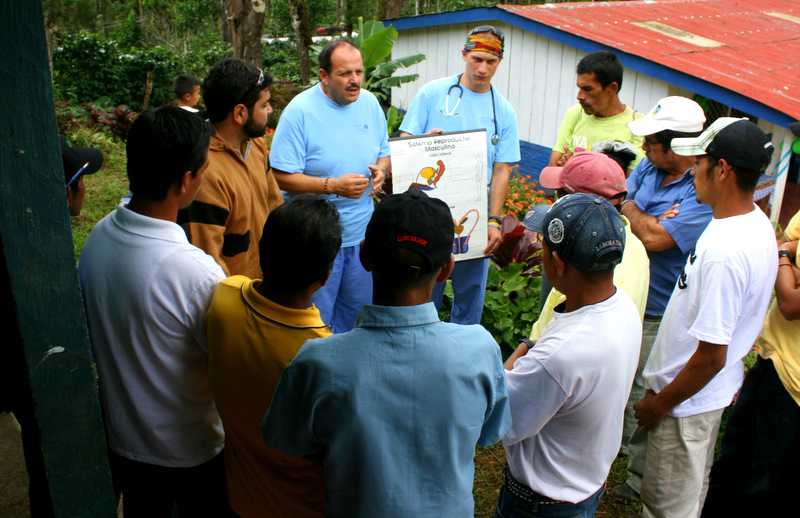
The RMU team hits the ground running and doesn’t stop. For six hours, there is endless activity at all stations. Dr. Ross educates the men on common health issues…


…while inside, the DNP students staff the exam rooms, treating patients of all ages for ailments ranging from moles to macular degeneration.


The undergrads stay busy delivering presentations…


…and triaging patients on the veranda.


Meanwhile, outside the clinic, the children’s boundless enthusiasm is so infectious, they threaten to run our young Olympian ragged in the yard with their cat-and-mouse games of chase.


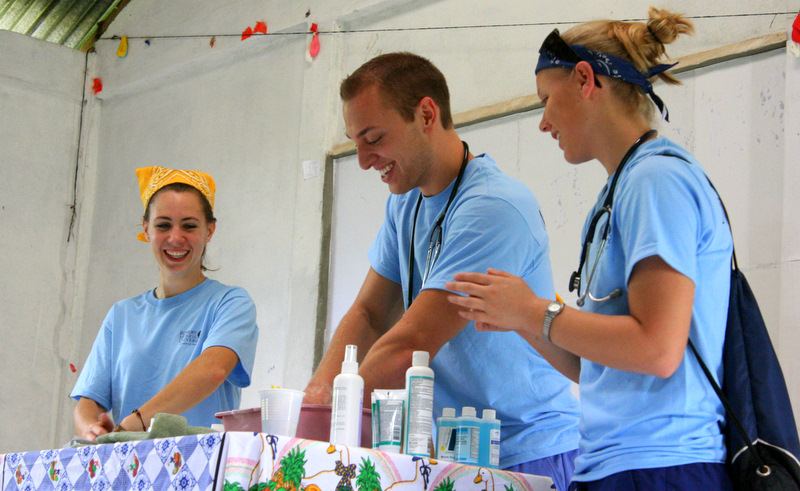
The lesson’s from today’s health fair are elementary in nature, but crucial in importance. We talk about handwashing. We demonstrate teeth brushing. We show the kids what stop-drop-and-roll is all about. In return, the lessons this isolated community teaches us are simple as well...

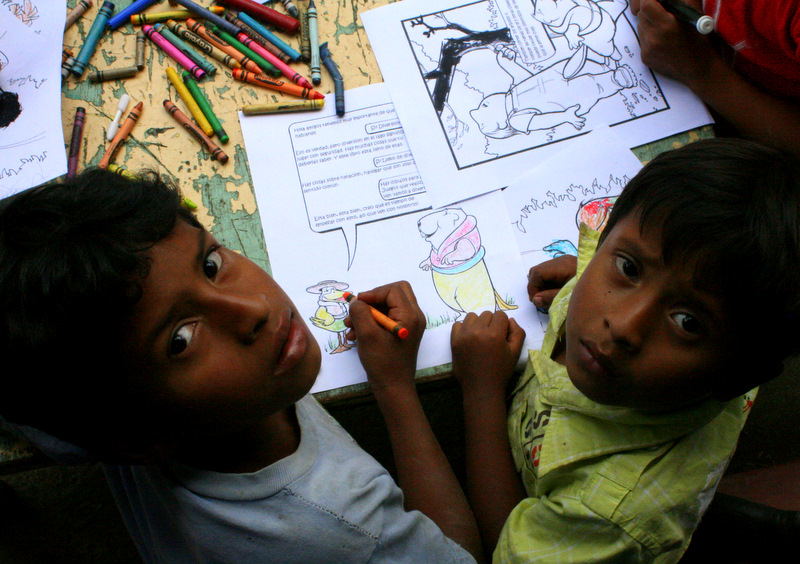
You’re never too old for Crayons. 


Laughing is a great form of exercise.


Sack races are only won through teamwork.


And most importantly, friendships come easy when you start them off with a smile….


….even if you're somewhere in the middle of nowhere.